

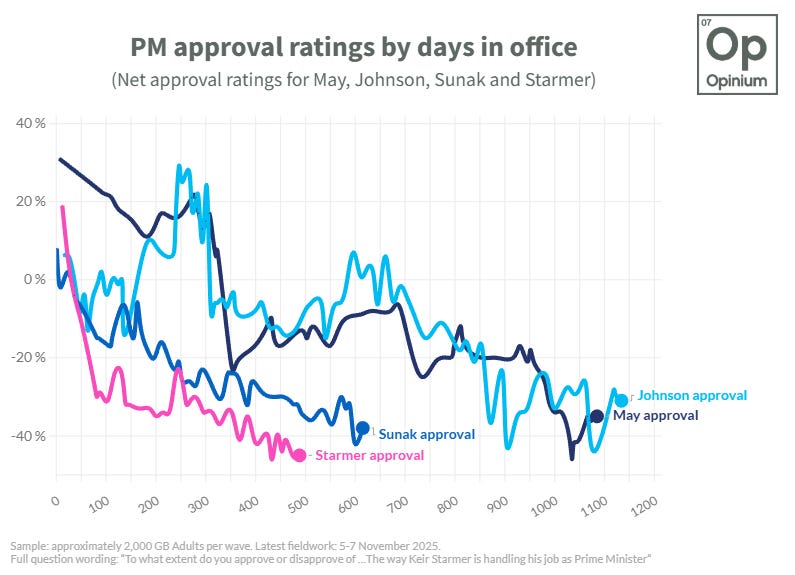
The latest leadership crisis in the Labour Party, thanks to the bizarre briefing war that came out of 10 Downing Street, pushed us to ask “how did we get here?”. Recently we wrote up how Keir Starmer has actually been near-historically unpopular for months now, but that this isn’t actually that new. In fact, Keir Starmer became incredibly unpopular within months of taking office, and the past 12 to 14 months have essentially been the slow erosion of what residual support he had left after his first 100 days in office, leaving him at a near-historic low. (We’re still waiting for him to break through Theresa May’s record low of net -46.)
Yes, there’s been a lot of water under the bridge since the summer and autumn of 2024, but for now, please indulge me. Let’s go back and, step-by-step, see how the first few months in office cut this government off at the legs and left Keir Starmer in the minus 30s even before his government’s first fiscal event.
What you will find from revisiting the below is that the government’s various policy and political challenges did it no favours, but the real damage was scandal. In particular, Freebiegate. It went on week after week, touching large parts of the government. And when you have a scandal-rocked administration, the political problems take on a new toxicity that is hard to row back from. Here is how the Starmer government unravelled between the 4th July and 18th October 2024.
A promising start amid prisons crisis (4th–19th July)
The Labour government came in with all the usual sense of victory that comes from any party that has won a general election, especially when won by a colossal landslide. This is despite claims it was a mile wide and an inch deep.
The prisons crisis pounced on the government in its very earliest days, with overcrowding forcing the government to consider the emergency release of thousands of inmates. Starmer presented himself as firm but pragmatic, stressing that violent or sexual offenders would not be freed. People (probably fairly) accepted it was the fault of the last government.
Despite the political risk, the government’s swift action initially reassured the public. The handling of the crisis was seen as evidence of a leader willing to make hard choices. By mid-July, the numbers reflected this: his approval had sat at net +18 (38% approve, 20% disapprove). Even with this unenviable first challenge, the new administration appeared competent, decisive, and—most importantly—different from its predecessors.
Poll at end of period: 17–19 July 2024 – Starmer approval at net +19 (38% approve, 20% disapprove; difference in net due to rounding)
A summer of setbacks (19th July–2nd August)
This reasonable start did not last. Trouble began in Wales, where First Minister Vaughan Gething was on the route to resigning amid allegations over donations and the deletion of pandemic-era messages. The episode, though devolved, reflected badly on Labour’s integrity narrative and was the first hint of the money and influence scandals that would hit far harder later in the summer.
Meanwhile, the prisons crisis lingered, and now victims’ groups condemned the early release scheme. Simultaneously, internal Labour divisions broke into the open. On 23rd July, the Prime Minister suspended seven rebel MPs for defying the government over the two-child benefit cap, a policy many in the party had pledged to abolish. Some said it was a sign of strength, but many thought it was high handed and was the first sign of the government’s difficult relationship with its own MPs.
By the end of the month, non-Labour voters were beginning to sour on the new government (to some extent just partisan ‘sorting’). The sense that Starmer was leading a pro-EU administration began to alienate Leave-leaning voters, an impression reinforced by his Blenheim Palace summit with EU leaders on the 18th July and talk of a “UK-EU reset.”
Then came the government’s first major economic stumble. On 29th July, Chancellor Rachel Reeves unveiled the full scale of a supposed £22 billion “black hole” in the public finances and announced the scrapping of Winter Fuel Payments for around ten million pensioners not on benefits. The reaction was furious. Among over-65s, disapproval of Starmer’s government doubled from 27% to 52% within days.
The blow was compounded by tragedy. The Southport stabbing and the riots that followed created an atmosphere of anxiety and division. During our polling conducted 31 July–2 August, Starmer’s net approval had fallen back by a whole 15 points to +3. The early glow had gone.
Poll at end of period: 31 July–2 August 2024 – Starmer approval at net +3 (35% approve, 32% disapprove)
A government under scrutiny (2nd–16th August)
The next phase saw the government’s vulnerabilities multiply. The riots were eventually contained, but their political aftermath proved thorny. On the right, many viewed the response as heavy-handed and symptomatic of a two-tier approach to policing, particularly after the controversy over prisoner releases. At the same time, the government’s economic message began to unravel. Analysts at the IFS questioned the Chancellor’s framing of the fiscal “black hole”, accusing ministers of spin.
Signs of dysfunction inside Downing Street also emerged. On 13 August, the FT reported that officials were concerned about bottlenecks caused by chief of staff Sue Gray, while rumours circulated of tension between Gray and Morgan McSweeney, Starmer’s long-time strategist.
Then there was a theme that was picked up again around money and influence, this time relating to the City Minister Tulip Siddiq. While she didn’t yet resign and was cleared in an initial investigation, the story wasn’t helpful and lingered. Then the Chancellor faced scrutiny for appointing a major Labour donor to a senior Treasury role.
By mid-month, approval had slipped again by a further nine points to net –6 (32% approve, 38% disapprove).
Poll at end of period: 14–16 August 2024 – Starmer approval at net –6 (32% approve, 38% disapprove)
“Painful choices” and the first major scandal erupts (16th–30th August)
In the second half of August, the problems escalated. Starmer warned that the upcoming Budget would be “painful”, citing the fiscal black hole as justification for spending restraint and possible tax rises. Critics on both left and right pounced, accusing Labour of preparing a new round of austerity.
Then came the government’s first major scandal which actually cut through. Reports surfaced about Lord Alli, a prominent Labour donor who had been granted a temporary No 10 pass and was said to have showered ministers with expensive gifts. Though the details initially seemed minor, the story fed into a growing perception of entitlement and poor judgement at the top. “Freebiegate” began to rumble across the government.
By the 30th August, the small scandal with the Labour donor in the Treasury came back to bite the government with the civil service appointments watchdog launching a review of exceptional appointments to official jobs after a row about alleged cronyism.
By now the Prime Minister’s approval ratings dropped a further six points to net –12 (31% approve, 43% disapprove). It’s fair to say any element of there being a political honeymoon was long over by now.
Poll at end of period: 28–30 August 2024 – Starmer approval at net –12 (31% approve, 43% disapprove)
Scandal and disarray (1st–20th September)
Early September brought further trouble for Rachel Reeves, as her handling of the Winter Fuel Payment cuts came under intense attack. Labour MPs were increasingly restless: 52 abstained or were absent during a key vote on the policy.
Meanwhile, the Alli revelations exploded. Between mid and late September, an endless line up of damaging stories dominated headlines: claims that Alli funded seven Cabinet ministers, that Starmer may have broken rules over gifts to his wife, and that Deputy Prime Minister Angela Rayner had used Alli’s New York apartment. There were endless other stories, related to Alli or otherwise.
Other unrelated scandals compounded the sense of rot. Labour MP Jas Athwal apologised for the state of properties he owned, and revelations about a £4 million donation from a Cayman Islands-based hedge fund (with interests in oil and arms) undermined the party’s clean image even further.
These scandals were compounded by clumsy and avoidable problems from within his own team, with it being reported on 18th September that Sue Gray was paid more than the Prime Minister.
By the run-up to the party’s first conference in power since 2009, Starmer’s approval had plummeted by a further 14 points to net –26 (24% approve, 50% disapprove). What had started as an image of competence was now overshadowed by a scandal-rocked government.
Poll at end of period: 18–20 September 2024 – Starmer approval at net –26 (24% approve, 50% disapprove)
The conference that wasn’t (20th–27th September)
Labour’s annual conference should have been a moment of renewal and celebration. Instead, the party was almost shell shocked. Labour, baffled by how quickly its popularity had evaporated, struggled to project confidence. Starmer’s own performance did little to lift spirits.
Voters in our polling described his speech as “dull”, “repetitive”, “directionless”, and “depressing.” More importantly, the Prime Minister made the embarrassing “sausages” gaffe that became the week’s story, heaping ridicule on a PM hoping to fight back.
Immediately after the conference, Starmer’s net approval hit –30 (23% approve, 53% disapprove), a 48-point swing from his mid-July high. In barely twelve weeks, the man who had promised to restore integrity and stability to British politics found himself engulfed by the same currents of scandal that had undone Johnson and Sunak.
Poll at end of period: 25–27 September 2024 – Starmer approval at net –30 (23% approve, 53% disapprove)
Post-conference disarray (2nd–18th October)
The Conservative Conference was preoccupied by the leadership race, and generally didn’t make much of an impact on wider public consciousness. However, that being said, the government was creating plenty of negative news for itself.
The major crisis was in his own team. By 7th October it was clear Sue Gray’s time as the Prime Minister’s chief aide was untenable, cue days of discussion about how and why the Prime Minister could have lost such a key adviser essentially within his first 100 days in office.
“Freebiegate” continued unabated. Straight after Tory conference, Keir Starmer repaid more than £6,000 in gifts after the donations row, only for the row over Taylor Swift tickets and whether or not he met everyone’s favourite popstar to carry on for pretty much this entire period.
All while the government was consumed by speculation about the scale of punishment in the upcoming Budget, inside a political vacuum where a government not looking in control had unleashed (for the first of what is now multiple times in this government’s short period in office) an endless period of doom-mongering and negative expectations.
Poll at end of period: 16–18 October 2024 – Starmer approval at net –31 (21% approve, 53% disapprove, difference in net due to rounding)
The striking thing about this list is how little it has to do with government. It is a sad comment on our politics that a government with a substantial agenda of legislation, most of which most people would approve of, is getting no credit for it at all. Nor is Starmer being credited with restoring Britain's international standing, in the US, EU, Ukraine and globally.